



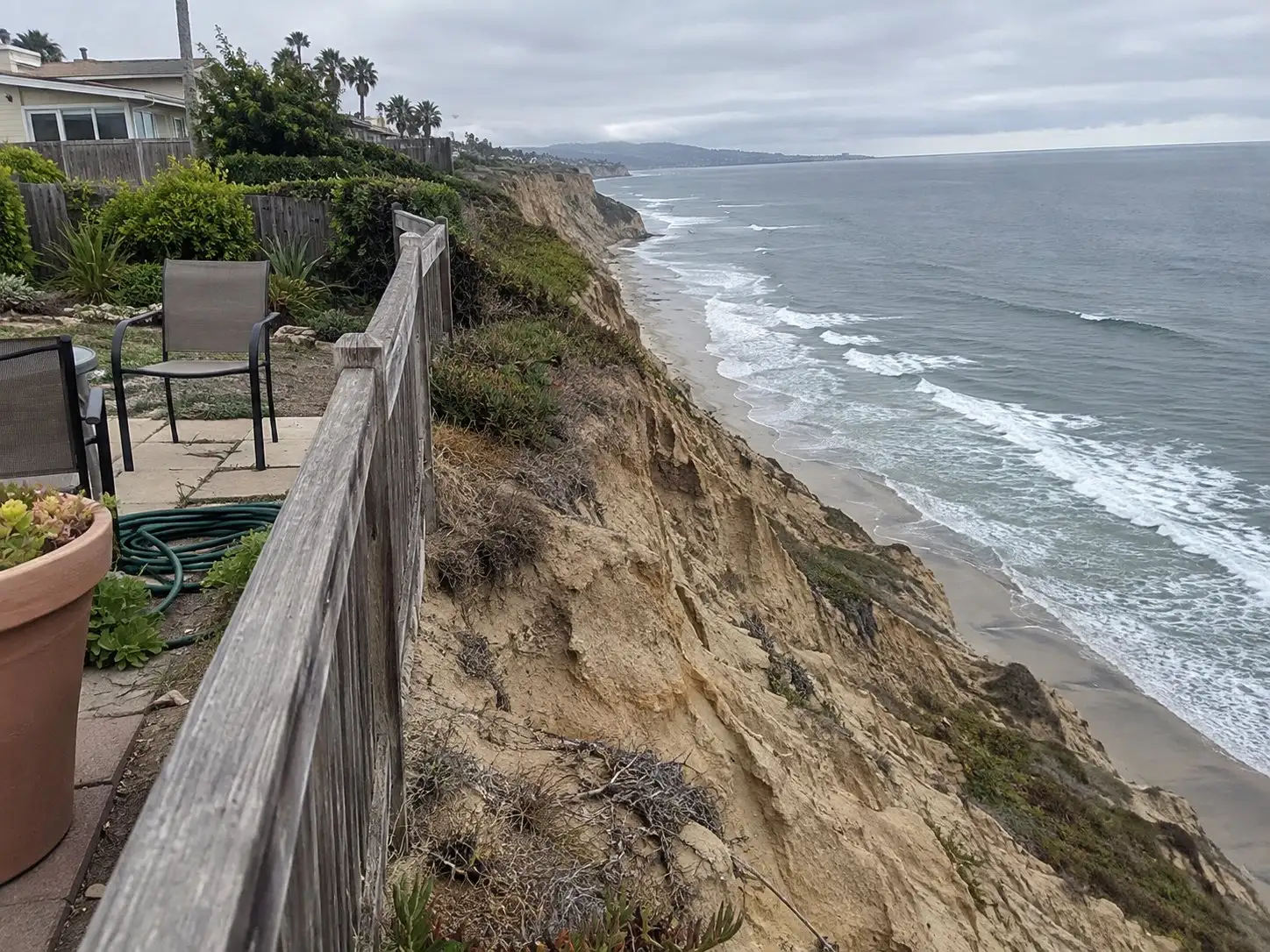
A bluff-top lot in Encinitas comes with a view most buyers want and a set of rules most buyers have never had to think about. The city treats the ground itself as the variable. Where a flat inland lot mostly cares about setbacks from the property line, a bluff lot has to answer a harder question: how much of that ground will still be there in 75 years.
What the Coastal Bluff Overlay Zone actually covers
The Coastal Bluff Overlay Zone is a layer of extra rules the city applies on top of normal zoning wherever a lot sits on or near a coastal bluff. Encinitas Municipal Code 30.34.020 spells it out. A principal structure has to sit at least 40 feet back from the bluff edge, and permanent irrigation is barred within that same 40 feet, since watering the bluff face is one of the more common ways people accelerate erosion without realizing it. There is a narrow exception that lets an addition sit closer than 40 feet if it stays behind an existing wall that is already there, but that is the exception, not the starting point.
That 40 feet is a floor, not the whole answer. It is the minimum the code will accept before the site-specific analysis even starts.
How the real setback gets calculated
The actual line on your lot comes from a geotechnical study, not just the code section. Encinitas requires the setback to keep the structure reasonably safe from bluff failure and erosion for its full life span, which in practice means the geotechnical report has to show a factor of safety of 1.5 both today and 75 years out. The engineer estimates how far the bluff edge is likely to retreat over that 75-year window, then adds the distance needed to hold that 1.5 factor of safety. Add those two numbers together and you get the required setback for that specific lot, which is often well past the 40-foot floor.
This is why two lots on the same street can carry different buildable envelopes. One may sit on a more stable bluff with less projected retreat. The other may need a deeper setback because the geology or the erosion history says so. There is no substitute for reading the actual report for the address in question.
When a geotechnical report is required
Any permit or development approval on a lot inside the Coastal Bluff Overlay Zone has to come with a soils report and a geotechnical review or report. That report has to give a professional opinion on whether the project can be designed or sited so it neither suffers from nor contributes to geologic instability over its lifetime. This applies to a full rebuild, and it can also apply to additions, pools, decks, or other work close enough to the bluff edge to matter. If you are remodeling rather than building new, ask early whether your scope triggers this requirement, because it changes both the timeline and what you are allowed to build.
Coastal Development Permits and who signs off
Most bluff-area projects in Encinitas go through the city, not directly through the state. Encinitas has held its own Coastal Development Permit authority since 1995, under a Local Coastal Program the California Coastal Commission certified that year. The city’s Local Coastal Program has two parts, a Land Use Plan and an Implementation Plan, and Municipal Code Chapter 30.80 governs how a Coastal Development Permit application moves through the city.
The Coastal Commission does not disappear from the picture, though. It keeps direct permit jurisdiction over tidelands and a short list of other categories, and separately it keeps appeal jurisdiction over a defined coastal zone that includes any area within 300 feet of the top of the seaward face of a coastal bluff. A city approval on a bluff-top lot can be appealed to the Commission on the grounds that it does not conform to the certified Local Coastal Program. For a buyer or seller, that means a bluff-top approval is not always final the day the city signs it. Check whether the appeal window has closed before treating a permit as settled.
What limits apply to seawalls and shoreline protection
State law does not treat a seawall as an automatic right. Public Resources Code 30235, part of the Coastal Act, allows shoreline protective devices such as seawalls, revetments, and cliff retaining walls when they are needed to protect an existing structure genuinely in danger from erosion, and when the design eliminates or mitigates damage to the local shoreline sand supply. That is a real standard to meet, not a formality.
On top of that, Encinitas approvals for new bluff-top development have in practice come with a condition requiring the owner to waive the right to ever seek shoreline armoring to protect that specific structure. If that condition is on the permit for a property, it usually gets carried forward as a recorded restriction on the title. Buying a bluff-top home does not automatically mean you can add a seawall later if erosion gets close. Check the permit history and the title, not just the assumption.
What a buyer should check before writing an offer
Start with the geotechnical or soils report for the specific address, not a general bluff-stability opinion for the neighborhood. Ask for the permit history on any upper-bluff work, retaining walls, or shoreline protection, since unpermitted grading or drainage changes near a bluff edge are exactly the kind of thing that later gets flagged, and unpermitted work still has to be disclosed if the seller knows about it. Pull the title report and read the actual language of any recorded waiver of future shoreline protection rather than relying on a summary of it.
A bluff is not one of the six zones covered by the state’s Natural Hazard Disclosure report, so a clean NHD statement tells you nothing about bluff stability. That is a separate document you have to go find. Zarko Maletin, who holds an InterNACHI home inspector certification alongside his real estate license, can walk a bluff-adjacent property with both those trainings in mind, but a structural home inspection is still not a substitute for the geotechnical report itself.
How this affects remodel and rebuild plans
A remodel that stays inside the existing footprint faces a lighter review than a full rebuild, but “lighter” does not mean automatic. Anything that adds square footage, moves closer to the bluff edge, or adds a pool, deck, or irrigation near the edge can trigger the same geotechnical and Coastal Development Permit process a new build would face. A full rebuild almost always requires a fresh geotechnical report, since the 75-year projection the last one used may no longer be current, and the setback that applied to the original 1970s or 1980s home on the lot may not be the setback a new structure gets today. Budget the time for this before assuming a like-for-like rebuild is a quick process.
The short version
A bluff-top Encinitas lot comes with a 40-foot minimum setback that is usually just the starting point, a required geotechnical report that sets the real number, and a permit process that runs through the city but can still land in front of the Coastal Commission on appeal. Some of these homes also carry a recorded waiver against future seawalls. None of that should scare you off a bluff-top purchase. It should just move to the top of your due diligence list, right next to the seller disclosure paperwork itself.
If you are weighing a bluff-adjacent property, in Encinitas or nearby, the home value tool is a starting point before a conversation about your specific lot.
Common questions
How far back from the bluff edge does Encinitas require new construction?
Encinitas Municipal Code 30.34.020, the Coastal Bluff Overlay Zone, sets a minimum 40-foot setback from the bluff edge for a principal structure, with a narrow exception for additions that stay behind an existing wall already closer than 40 feet. No permanent irrigation is allowed within 40 feet of the bluff edge either. The final setback on a given lot can end up larger once the geotechnical report factors in site-specific erosion.
Do I need a geotechnical report to build on a bluff-top lot in Encinitas?
Yes. Any permit application for property in the Coastal Bluff Overlay Zone has to include a soils report along with a geotechnical review or report. That report gives a professional opinion on whether the project can be sited so it stays geologically stable for its full life span, and it is the document that ultimately sets the real setback line on your lot.
Who issues the permit, the city or the Coastal Commission?
Usually the city. Encinitas has held its own Coastal Development Permit authority since 1995 under its certified Local Coastal Program. The California Coastal Commission keeps direct jurisdiction over tidelands and a few other categories, and it can hear an appeal of a city decision on a bluff-top or near-shore project, since those sit inside its appeal zone.
Can I build a seawall to protect a bluff-top home in Encinitas?
Sometimes, under Public Resources Code 30235, when an existing structure is genuinely in danger from erosion and the design avoids or offsets damage to the shoreline sand supply. Many Encinitas bluff-top approvals also come with a condition waiving the owner's right to ever seek shoreline armoring for that structure, so check the permit and the title before assuming a seawall is an option later.
Does a bluff-top home come with any deed restrictions I should know about?
It can. Some Encinitas coastal development permits condition approval on the owner recording a waiver of future shoreline protection, meaning the property gives up the right to ask for a seawall to protect that structure later. A title search and a review of the permit file for the address are the only ways to know for sure.
